The statement of shareholders’ equity records changes in a company’s equity over a specific period, detailing how activities such as issuing shares, repurchasing stock, or distributing dividends affect ownership structure. This transparency enables stakeholders to assess the company’s financial health and strategic decisions. It is a financial document that a company issues as part of its balance sheet details, and it gives investors information about why accounts have changed. It gives investors more transparency about the changes in equity accounts and reports on the business activities that contribute to the movement in the value of shareholders’ equity. It is essentially the net worth of the shareholders’ stake in the company and includes items such as retained earnings, share buybacks, dividend payments, and other stock-based compensation for the period.

Importance of Shareholders Equity Statement
- Treasury stock refers to shares repurchased from the open market and held by the company.
- However, those separate legal corporations (called subsidiaries) are owned and controlled by one of the corporations (the parent corporation).
- For example, issuing 1,000 shares at $10 each with a par value of $1 increases the common stock account by $1,000 and additional paid-in capital by $9,000.
- It connects the equity section of the balance sheet from the beginning of an accounting period to the end of that period.
- The statement outlines equity activity, including common stock issued, dividends paid, and changes in retained earnings.
- The actual number of shares issued (also called issued share capital) will not be more than the authorized share capital.
As a result these items are not reported among the assets appearing on the balance sheet. This is defined as the amount of cash from operating activities minus the amount of cash required for capital expenditures. Some people also subtract the corporation’s cash dividends when the dividends are viewed as a Accounts Receivable Outsourcing necessity. If the company issued new shares during the period, the proceeds from the issuance would increase equity. Conversely, if the company bought back shares (treasury stock), it would decrease equity.

What are key ratios and metrics for analyzing stockholders’ equity?
- For example, a corporation could have an accounting year that begins on July 1 and ends on the following June 30.
- Key ratios and metrics include the debt-to-equity ratio, return on equity (ROE), and book value per share.
- Contributed capital, or paid-in capital, represents the total value of cash and other assets shareholders invest in the company in exchange for stock.
- Foreign currency transactions and hedging transactions were done as investments.
- If the losses exceed the available retained earnings, it might eat into other areas of equity – this situation can lead to negative shareholders equity.
This could be investing in expansion through the purchase of what are retained earnings property, plant and equipment, possibly mergers or to pay its debts. A company that has been consistently profitable will typically have a large retained earnings account. These represent the accumulated company’s profits that are not paid out as dividends to the shareholders and instead allocated back into the business. Retained earnings could be used funding working capital requirements, debt servicing, fixed asset purchases, etc.

How To Create A Statement Of Shareholder Equity?
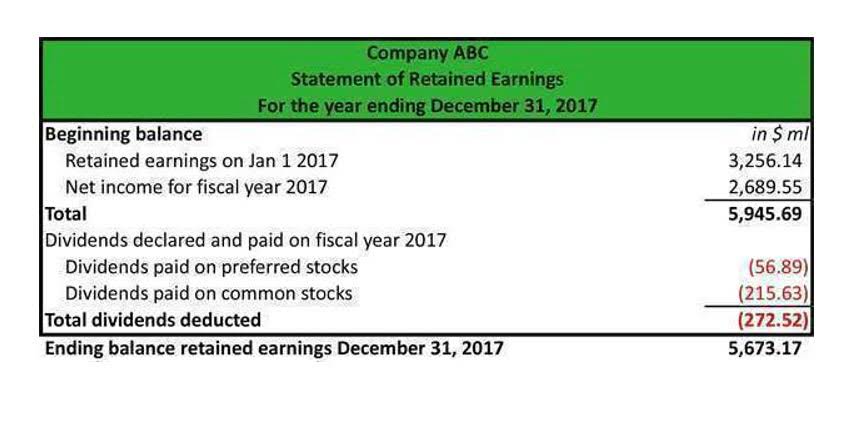
- Subtract any dividends (for corporations) or owner withdrawals (for smaller businesses or sole proprietorships) from the total.
- As illustrated by this Home Depot statement, stockholders’ equity equals total paid-in capital plus retained earnings minus treasury stock.
- This extract details the movements in shareholders’ equity (or stockholders’ equity) from the start of the period, January 1st 2016 to the end of the period, December 31st 2016.
- If an organization’s return on equity is below its cost of equity, this indicates that it’s not rewarding its shareholders adequately for the risk they bear to invest their funds in the company.
A corporation statement of stockholders equity is required to issue annual financial statements, but it is common for a corporation to prepare monthly financial statements for its management. Financial statements issued between the annual financial statements are known as interim financial statements. Interim financial statements could be prepared for periods such as one month, four weeks, three months, 13 weeks, eight months, eleven months, etc.
In other words, in fiscal year 2019, there were no significant issues of new common stock. The easiest and simplest way of calculating stockholders’ equity is by using the basic accounting equation. For example, if a company is showing strong growth in the statement of stockholders’ equity, then that shows that they are investing in new projects and increasing their shareholder’s equity. The journal entry to record this would be to debit the dividends payable and credit cash accounts. These roles underscore the statement’s importance in fostering good corporate governance practices.
Statement of Owner’s Equity vs. Cash Flow Statement
The common stockholder is usually the last one to get paid after all debtholders and preferred stockholders get their due amounts. On the contrary, a decrease in shareholders equity could be a potential red flag. It might be the result of persistent losses, high amounts of dividends being paid out, or even a corporation issuing more debt. Such changes could suggest potential financial distress, and may, in some scenarios, even hint at bankruptcy risks. Understanding and analyzing changes in shareholders equity can provide insightful information on the financial health and performance of a company.
Format of a Statement of Stockholders’ Equity
Conversely, a consistently decreasing equity may imply potential financial distress. Retained earnings, as the name suggests, are the amount of net income that a company has kept (retained) over the years after paying off dividends. This component is quite indicative of the company’s financial health as it shows the extent to which it can finance its own operations and growth using the profits it has generated. An increase in retained earnings year over year can signal a company that is healthy and profitable, whereas a decrease may raise a red flag.